
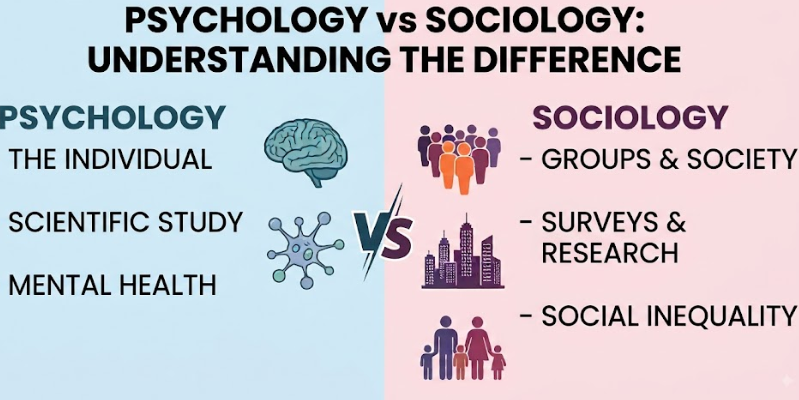
Psychology and Sociology are two popular subjects within the social sciences that help students understand people and society from different perspectives. Psychology primarily focuses on human behaviour, emotions, thoughts and mental processes, while Sociology examines society, social relationships, institutions and group behaviour. Psychology focuses more on individuals, while Sociology focuses more on society and social structures.
Students often compare Psychology vs Sociology when selecting an undergraduate course or planning a career in the social sciences. Although both subjects involve the study of human behaviour, their approach, subjects, research methods and career opportunities can be quite different. Psychology may involve studying cognitive processes, personality, development and behaviour, whereas Sociology explores communities, cultures, social inequality, institutions and social change. Both subjects offer diverse academic and career opportunities, but they suit different interests.
Choosing between Psychology and Sociology depends on your academic interests, career goals and the type of work you want to pursue. Students interested in understanding individual behaviour and mental processes may find Psychology more suitable, while those interested in society, communities, culture and social issues may prefer Sociology. The right choice depends on your interests, strengths and long-term career plans.
What is Psychology?
Psychology is the scientific study of human behaviour and mental processes. It examines how people think, feel, learn, develop and behave in different situations.
Psychology covers several areas, including cognitive psychology, developmental psychology, social psychology, organisational psychology, counselling psychology and clinical psychology.
Students studying Psychology learn about human development, memory, emotions, personality, learning, behaviour and psychological assessment. Depending on the programme and specialisation, students may also gain exposure to research methods and practical applications.
Psychology is a suitable field for students who are interested in understanding individual behaviour, thoughts and emotions.
What is Sociology?
Sociology is the systematic study of society, social relationships, groups, institutions and social behaviour. It examines how individuals interact with one another and how social structures influence people's lives.
Sociology covers topics such as family, education, religion, culture, social stratification, gender, population, urbanisation, social movements and social change.
Students learn how social institutions function and how factors such as culture, economic conditions, education and social norms influence communities.
Sociology focuses on society and the relationships between individuals, groups and institutions.
Psychology vs Sociology: Key Difference
Psychology and Sociology both study human behaviour, but they approach the subject from different perspectives.
Psychology generally focuses on the individual, including thoughts, emotions, personality and behaviour. Sociology looks at individuals as part of larger groups and examines how social environments and institutions influence behaviour.
| Factor | Psychology | Sociology |
|---|---|---|
| Main Focus | Individual behaviour and mental processes | Society and social relationships |
| Study Level | Mostly individual | Groups, communities and institutions |
| Major Topics | Emotions, personality, cognition, behaviour | Culture, inequality, institutions, social change |
| Research | Experiments, assessments, surveys and observation | Surveys, interviews, observation and social research |
| Career Areas | Counselling, HR, research, mental health-related fields | Social research, NGOs, policy, development and social services |
| Suitable For | Students interested in individual behaviour | Students interested in society and social issues |
Psychology Subjects
The subjects in Psychology depend on the university and programme. Common topics may include:
- Introduction to Psychology
- Cognitive Psychology
- Developmental Psychology
- Social Psychology
- Personality Psychology
- Biological Psychology
- Abnormal Psychology
- Research Methodology
- Statistics
- Counselling Psychology
- Organisational Psychology
What Do Psychology Students Learn?
Psychology students learn how human behaviour is influenced by biological, cognitive, emotional and environmental factors.
They may also develop skills in research, observation, communication, assessment and data interpretation.
Psychology combines theoretical understanding of behaviour with research and practical applications.
Sociology Subjects
Sociology programmes may include subjects such as:
- Introduction to Sociology
- Sociological Theory
- Indian Society
- Social Institutions
- Social Stratification
- Sociology of Education
- Sociology of Family
- Rural and Urban Sociology
- Gender and Society
- Social Change
- Population Studies
- Research Methodology
What Do Sociology Students Learn?
Sociology students learn how social structures, institutions, cultures and communities influence people's lives.
They examine social issues and patterns using research methods such as surveys, interviews, observation and analysis of social data.
Sociology helps students understand how society operates and how social change takes place.
Eligibility for Psychology and Sociology
The eligibility requirements depend on the course and institution.
Psychology Eligibility
Students who want to pursue undergraduate Psychology programmes generally need to complete Class 12 from a recognised board. Some institutions may have specific subject or minimum percentage requirements.
For postgraduate Psychology programmes, candidates generally need a relevant bachelor's degree and must fulfil the admission criteria of the institution.
Sociology Eligibility
Students can generally pursue undergraduate Sociology after completing Class 12 from a recognised board. The specific percentage and admission requirements vary by college or university.
For postgraduate Sociology programmes, candidates generally need a relevant bachelor's degree.
Students should check the latest eligibility and admission requirements of their preferred institution before applying.
Career Scope After Psychology
Psychology offers career opportunities across several sectors. Graduates can explore careers related to human behaviour, research, education, organisations and social services.
Counselling and Mental Health-Related Fields
Students with appropriate qualifications and professional training can explore counselling and other mental health-related career areas. Certain professional roles require advanced degrees, supervised training and applicable registration or licensing requirements.
Human Resources
Psychology graduates can work in recruitment, employee engagement, training, organisational development and other HR functions.
Research
Students interested in research can work on behavioural studies, academic projects and social or market research.
Education
Psychology graduates can explore teaching and educational support roles depending on their qualifications.
Organisational Psychology
With specialised education, students can work in areas related to workplace behaviour, employee motivation and organisational development.
Psychology offers career options across education, organisations, research and behaviour-related fields.
Career Scope After Sociology
Sociology also provides a wide range of career opportunities.
Social Research
Sociology graduates can work in research organisations, survey agencies and institutions involved in studying social trends.
NGOs and Social Development
Graduates can work with NGOs and development organisations on community development, education, social welfare and related projects.
Government and Public Policy
Sociology can provide a useful foundation for careers related to public administration, social policy and development, subject to the required qualifications and recruitment criteria.
Human Resources
Sociology graduates can also enter HR because their understanding of groups, communication and organisational behaviour can be useful in workplace settings.
Journalism and Media
Knowledge of society and social issues can be useful in journalism, content research, media and communication-related roles.
Sociology is particularly useful for students interested in society, social development, research and public issues.
Skills Required for Psychology
Students interested in Psychology can benefit from developing:
- Communication skills
- Active listening
- Observation skills
- Analytical thinking
- Research skills
- Emotional awareness
- Data interpretation
- Problem-solving
- Scientific thinking
- Report writing
Why Are These Skills Important?
Psychology involves understanding behaviour, analysing information and communicating findings clearly. Research and data analysis skills are particularly useful for higher studies and professional roles.
Skills Required for Sociology
Sociology students can develop:
- Research skills
- Critical thinking
- Communication
- Data analysis
- Observation
- Social awareness
- Writing skills
- Interviewing skills
- Problem-solving
- Analytical reasoning
Why Are These Skills Important?
Sociology involves studying social patterns and institutions. Strong research and analytical abilities help students understand social issues and interpret information effectively.
Psychology vs Sociology: Which Is Easier?
There is no universally easier subject. The difficulty depends on the student's interests and academic strengths.
Students who enjoy studying individual behaviour, cognitive processes, emotions and scientific research may find Psychology easier to understand.
Students who enjoy reading about society, culture, social institutions, communities and social issues may find Sociology more comfortable.
The subject that matches your interests is often easier to study and understand.
Psychology vs Sociology: Which Is Better?
Psychology may be a better choice for students who are interested in human behaviour, emotions, personality, learning, counselling-related fields, HR or behavioural research.
Sociology may be more suitable for students interested in society, culture, communities, social inequality, development, social research and public issues.
Both subjects can lead to higher studies and professional opportunities. Students should consider the curriculum, college, future specialisation and career requirements before making a decision.
Points to Consider Before Choosing
- Identify whether you are more interested in individuals or society.
- Compare the syllabus of the colleges you are considering.
- Check the eligibility requirements.
- Explore career opportunities after graduation.
- Consider whether you want to pursue postgraduate education.
- Research specialisations available in your preferred field.
- Consider your strengths in research, writing and analysis.
- Check professional requirements for specialised careers.
- Look at internship and practical learning opportunities.
- Choose the subject that matches your long-term career goals.
Conclusion
Psychology vs Sociology is an important comparison for students who want to build a career in the social sciences. Psychology focuses primarily on individual behaviour, thoughts, emotions and mental processes, while Sociology examines society, groups, institutions, culture and social relationships.Students interested in understanding people at an individual level may find Psychology more suitable, while those who enjoy studying social structures, communities and social issues may prefer Sociology. Both subjects offer valuable career opportunities, but the right choice depends on your interests, skills and long-term goals.
|
Also Read |