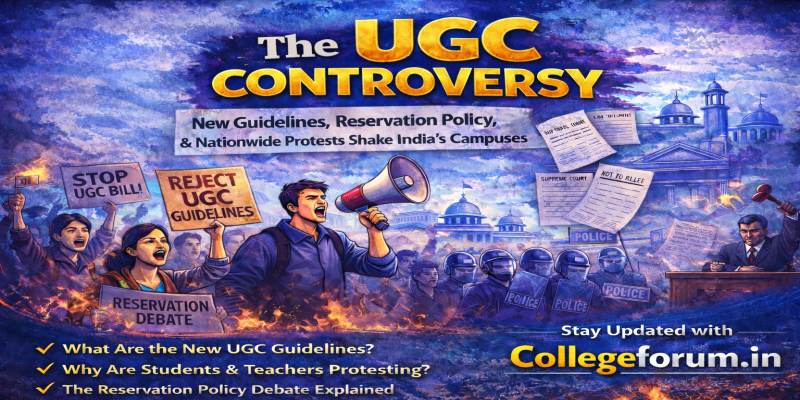
In January 2026, the University Grants Commission introduced a fresh set of regulations aimed at promoting equity and addressing discrimination in Indian higher education institutions. What was initially presented as a progressive reform soon turned into a flashpoint of intense debate across the country. Students, teachers, and academic bodies began raising serious concerns, leading to nationwide demonstrations and legal challenges. This development has since evolved into a major ugc controversy, drawing the attention of policymakers, courts, and the general public.
At the heart of this debate are the new guidelines, which many believe significantly alter how issues of discrimination, reservation, and institutional governance are handled within universities. While supporters argue that these reforms are long overdue, critics insist that the rules are vaguely worded and prone to misuse. The growing unrest has resulted in an unprecedented ugc protest movement on campuses, making the issue one of the most contested education reforms in recent years.
Understanding the New UGC Guidelines
The new guidelines, formally issued under the framework of equity promotion in higher education, were designed to strengthen mechanisms that address discrimination within universities and colleges. These guidelines require institutions to establish Equal Opportunity Centres, form equity committees, appoint grievance officers, and ensure structured complaint-handling procedures.
According to the UGC, earlier regulations lacked enforcement power, allowing discrimination complaints to remain unresolved. The new UGC guidelines aim to fix this gap by introducing monitoring systems and accountability mechanisms. Institutions are now expected to document complaints, submit periodic reports, and take preventive measures to create inclusive campuses.
These reforms are also being discussed in the context of a broader ugc bill-style overhaul of higher education governance. Although the regulations themselves are not a parliamentary bill, their scale and impact have led many to refer to them informally as a new bill in public discourse.
Key Highlights of the New UGC Guidelines
| Aspects | What the New UGC Guidelines Propose |
| Objective | Promote equity and address discrimination in higher education institutions |
| Applicability | All UGC-recognised universities and colleges in India |
| New Structures | Equal Opportunity Centres, Equity Committees, grievance officers |
| Reporting | Mandatory documentation and periodic reporting of complaints |
| Enforcement | Institutional accountability with UGC oversight |
| Earlier Framework | Replaces and strengthens the 2012 UGC guidelines |
| Public Response | Triggered protests and legal challenges nationwide |
Reservation and the Core of the Controversy
One of the most sensitive aspects of the debate relates to how the new guidelines intersect with reservation policies. Critics argue that the language of the regulations indirectly influences admissions, evaluations, and disciplinary actions, thereby affecting existing reservation norms.
Students from general and unreserved categories fear that loosely defined terms such as “discriminatory behaviour” could be interpreted subjectively. This, they claim, may result in reverse discrimination or unfair targeting. As a result, concerns over ugc reservation have become central to the opposition.
On the other hand, supporters maintain that the ugc guidelines do not alter constitutional reservation policies. Instead, they argue that the reforms simply ensure a safer and more inclusive environment for students from historically marginalised communities. According to them, the intent is corrective, not punitive.
Supporters vs Critics of the New UGC Guidelines
| Supporters’ View | Critics’ View |
| Needed to stop caste-based discrimination | Language is vague and open to misuse |
| Strengthens protection for marginalised students | Could lead to false or motivated complaints |
| Improves the accountability of institutions | May weaken academic autonomy |
| Complements existing reservation laws | Indirectly affects ugc reservation policies |
| Creates safer campuses | Risks of reverse discrimination |
Why Students and Academicians Are Protesting
The protests against the new UGC guidelines stem largely from two major concerns.
The first is ambiguity. Many academicians believe the guidelines lack precise definitions and procedural clarity. Without clear boundaries, they fear the regulations may be misused, leading to false complaints and reputational damage to students and faculty alike. This fear has fueled anger and uncertainty, transforming policy objections into street-level protests.
The second concern relates to institutional autonomy. Several university administrators and teacher associations argue that the new UGC guidelines allow excessive regulatory interference in academic affairs. They worry that mandatory oversight structures may restrict free academic debate and undermine the independence of universities.
These concerns quickly escalated into coordinated demonstrations across campuses, making the issue one of the most visible ugc protest movements in recent years and solidifying its status as a nationwide controversy.
Timeline of the UGC Controversy
| Date | Event |
| January 2026 | New UGC guidelines officially notified |
| Mid-January 2026 | Student and faculty protests begin |
| Late January 2026 | Multiple petitions filed in the Supreme Court |
| January 29, 2026 | Supreme Court stays implementation |
| January 30, 2026 | Government and UGC seek responses and revisions |
The Legal Intervention and Supreme Court Stay
As protests intensified, multiple petitions were filed in the Supreme Court challenging the constitutional validity of the new UGC guidelines. In January 2026, the Court issued an interim stay on their implementation, observing that several provisions appeared vague and potentially open to misuse.
The Court directed educational institutions to continue following the earlier 2012 ugc guidelines until further notice. This judicial intervention temporarily halted enforcement and shifted the debate from campuses to courtrooms. It also added legal weight to the ongoing ugc bill discussion surrounding regulatory authority and procedural fairness.
Legal experts have pointed out that the stay does not reject the idea of equity reforms outright. Instead, it emphasises the need for clarity, proportionality, and due process within the ugc bill-like framework proposed by the UGC.
Political Reactions and Public Debate
The controversy soon acquired political dimensions. Opposition parties accused the government of pushing poorly drafted regulations without sufficient consultation. Meanwhile, supporters of the reforms argued that resistance was rooted in discomfort with accountability.
Media narratives began framing the issue as a conflict between social justice and institutional freedom. Terms like ugc bill and new ugc bill were widely used, even though the reforms were introduced through regulatory notifications. This framing intensified public debate and widened ideological divisions. The political response further amplified the ugc controversy, ensuring that it remained in headlines well beyond academic circles.
What Happens Next?
The future of the new UGC guidelines now depends on judicial review, stakeholder consultations, and possible redrafting. Experts suggest that the UGC must clearly define key terms, introduce safeguards against misuse, and explicitly clarify how the rules relate to reservation laws.
There is also a growing demand for inclusive dialogue involving students, teachers, and administrators. Many believe that revising the new UGC guidelines through consultation would reduce distrust and improve acceptance.
If handled carefully, the reforms could strengthen accountability while respecting academic freedom. With clearer definitions, transparent procedures, and meaningful consultation with students and academicians, the guidelines have the potential to address genuine cases of discrimination without creating fear or uncertainty on campuses. A well-calibrated approach could help institutions become more inclusive while preserving open debate, independent research, and fair evaluation systems.
However, if the concerns raised by stakeholders are ignored and the rules are enforced without adequate safeguards, the backlash could deepen further. Continued ambiguity may fuel mistrust among students and faculty, leading to prolonged protests, legal challenges, and resistance at the institutional level. Over time, this could weaken confidence in regulatory bodies, strain campus relations, and undermine the very objective of promoting equity in higher education. The success of the reforms, therefore, depends not only on intent but also on thoughtful implementation and sustained dialogue.
Possible Outcomes of the New UGC Guidelines
| Scenario | Likely Impact |
| Guidelines Revised After Consultation | Better acceptance and reduced protests |
| Guidelines Implemented Without Changes | Continued protest and legal scrutiny |
| Guidelines Withdrawn | Policy setback for equity reforms |
| New Draft Introduced | Possible rebranding as a new policy |
Conclusion
The debate surrounding the new UGC guidelines reflects deeper tensions within Indian higher education. Questions of equity, reservation, autonomy, and governance are colliding in ways that demand thoughtful resolution. The protests and legal challenges are not merely reactions to a policy document; they represent broader anxieties about fairness and institutional power.
Whether the reforms eventually take shape as a revised bill or an amended set of the new ugc guidelines, their success will depend on transparency, clarity, and dialogue. As the Supreme Court deliberates and policymakers reconsider their approach, the outcome will likely shape the future of Indian campuses for years to come.